Thursday, December 12, 2013

Reflection 6

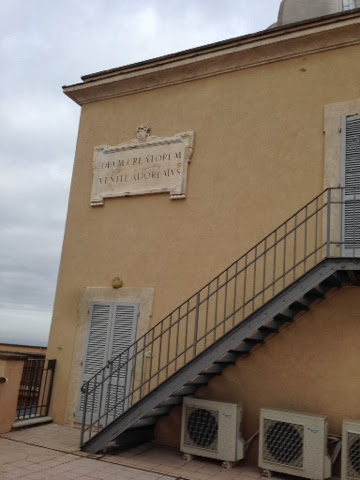
Being able to see the Vatican Observatory today was such an amazing experience! We got to see the balcony where the Pope gives his audiences when he's at this residence, the telescope used by the astronomers, and learn some history of battles fought around the property. One aspect I found interesting was Guy's discussion of why the Church needed to assert its pro-science position. Even though the issues with Copernicus and Galileo took place in the sixteenth and seventeenth centuries, it wasn't until the nineteenth century that the rumors of their anti-science stance began to come out. Many countries in Europe had become unified in that century, and opened up private universities. However, not a lot of people wanted to pay to attend them, when they could go to the Church's universities for free. To combat this the private universities started rumors that the church was against science, and so their schools would not offer as good of an education. This idea stuck, and so now the Vatican has had to fix their image and show that they support scientific discovery. 


I also thought it was interesting that it was the priests who were acting as scientists in the pre-modern era. They were the only ones in the community with time and literacy, so it makes sense. Additionally, Guy told us about his background, first as an astronomer, and then as a Jesuit. This reminded me of what we learned in lecture. Namely, that Jesuits were encouraged to study other fields, not just theology. It is clear that the Church was not actually trying to hinder the work of scientists. Rather, they wanted to make sure what people like Galileo were saying was actually accurate before they supported it. I think it is important also to remember the times in which these churchmen were living. No one, even general lay people, would have automatically believed what they had been taught their whole life was wrong. Therefore, I do not think that it was an issue of the Pope trying to shut Galileo up, but rather that they just wanted to fully understand what was happening. Seeing the observatory today helped drive all of that home, and made me realize that the Church is continuing to evolve even today, in order to keep up with the new research that comes out of the scientific community. 


Wednesday, December 11, 2013

Reflection 5

Seeing the Pope today was a cool way to see how the Catholic Church has evolved since Francis was elected. The Church has been facing issues like how to relate to a changing world, and accusations of child molestation. However, with this new leadership, it seems like people are really excited again about the direction the Church is heading in. We saw that this morning in the sheer number of people who turned up early just to be able to see Pope Francis. I don't have any way to compare it to the number of people who came to see Pope Benedict, but we learned in class that the Vatican does not really know how to deal with so many people for these audiences. Additionally, I learned this morning that the fact that Francis is the first Jesuit Pope, and that he is the first Pope from South America means people are more excited. It represents a shift towards representation of the undeveloped countries in the world, and the lower classes. Since Pope Francis also wants to conduct surveys to get an idea for the beliefs of Catholics, he is clearly trying to make sure the Church goes in a direction that will benefit everyone. I saw so much excitement when he came out in his popemobile, with so many people trying to take pictures and stand on their chairs to see him better, that it has to represent a more positive public opinion of the papacy.


The things that Pope Francis has already done to change the papacy have demonstrated that this is a pope who wants to go back to the actual teachings of Jesus. He rejected the fancy palace and the gaudy clothes in order to live more simply. He turned the house of a fired bishop into a soup kitchen, and there are rumors that he sneaks out at night to serve at a different soup kitchen. He is truly inspiring, even to an atheist like me, and I can't wait to see what else he will do.


Reflection 4

Yesterday was our Caravaggio day, so we presented on various paintings, then went around Rome to see them in person. My favorite painting was The Calling of St. Matthew. It was his first public commission, in 1599/1600. Seeing it in person was so much more inspiring than seeing a picture online had been, and the details were much clearer. It was easier to see Jesus' hand pointing towards Matthew, calling him to his side. I liked the fact that we are not sure which person is actually Matthew, even though the signs throughout the church all shower the man pointing in the middle as Matthew. I think the ambiguity adds meaning to the painting, because it invokes the idea that anyone could be called to Jesus at any time. He was just an ordinary tax collector, and was suddenly called to the church. It was also cool to see all three of Carravaggio's paintings of St. Matthew (his calling, his inspiration, and his martyrdom) hanging together, because it essentially showed his path to heaven and sainthood. One thing I thought was unusual was that all of the men sitting at the table were wearing clothes that were from Carravaggio's time period. That is definitely not what Matthew would have been wearing. However, Jesus and Peter are wearing clothes from the biblical era. I wonder why Carravaggio chose to make this distinction. 


I thought the format of this day was helpful for really understanding these pieces. Being able to talk about each painting and the process Carravaggio went through to get each one where it is today. Are it more special to see them in person. I also found it interesting how so many of his masterpieces were second or third editions. When the church didn't like what he had done, they made him paint a new one or cover up the old one. I can't imagine what his reaction must have been each time they told him to do it again. But like we saw from Michelango's movie, you don't really say no to the church. I wish they would have let him keep the originals, because they showed regular people, not holy saints. We learned in lecture that Carravaggio liked to use ordinary people and the drama of life on the streets as his models, which is more what you can see in his originals. But it does make sense that the church would want the saints portrayed in a more dignified manner. 

Tuesday, December 10, 2013

Food, Churches, and Art (what else is new?)

I've fallen a bit behind on my travel blogging, because I've been focusing first on my reflection blogs for class. So this is mostly going to be a photo log of what I've done the past few days, with captions for clarification. Enjoy!

Sunday was our second free day, so we travelled to find the gelato place recommended by two of my friends. It was every bit as good as I imagined!

Calzone by the Vatican! Then we wandered the shops to buy souvenirs for people back home. 

Amazing pesto pizza in this cute little cafe we found by the gelato place. I also got strawberry tiramisu that was super good, but I was too full to eat much of it.  

Monday we went to two baroque churches to discuss the Counter- (or Catholic) Reformation. There was a lot of gorgeous artwork because the idea was to amaze the viewer with a "surround sound" experience. 

Hot chocolate from some famous cafe. But not famous enough that any of us had ever heard of it so...

Much like the coliseum the first night, we just happened to walk across the pantheon on the way to the next church. Rome is so cool. 

3D lookin' ceiling in the second church. 

Santa band by the Spanish steps (where I finally decided to buy a knock off purse that I've been condidering all trip). 

I wish we had these in America. Water fountains everywhere!

Beautiful sunset walking out of the metro. 

Today we presented in groups about paintings by Caravaggio, then walked around Rome to the various churches that hold them. This was in the first church, with The Calling of Saint Matthew, The Inspiration of Saint Matthew, and The Martyrdom of Saint Matthew. We actually started in a museum of Capuchin artifacts, which included a crypt of bones displayed in artful arrangements. It was super fascinating, but we weren't allowed to take pictures. 

Apse of the first church


Piazza del Popolo (which is really fun to say). This is the first thing visitors from the north would see when they entered Rome. A lot of emphasis is placed on symmetry. 

This is the painting I was assigned to The Conversion of St. Paul. It's inside the Basilica di Santa Maria del Popolo, which was absolutely gorgeous. The Martyrdom of St. Peter was hanging opposite. 

Apse of the Basilica di Santa Maria del Popolo. I'm pretty sure the cross was crooked. 

The archway to Rome (back in the day at least) that looked into the Piazza del Popolo. 


And we ended the day with caico e pepe at the restaurant Caico e Pepe. Apparently some food or travel network guy went there and really liked it. It was surprisingly good despite the fact that I don't like pepper. 

We are waking up at 6 tomorrow to go see the Pope, so it's time for bed! Good night!

Reflection 3

The aspect of today's visits that I found the most interesting was the names. On the outside of the Church of the Jesu, I saw IHS in large letters inside of an oval. I knew that J is sometime seen as I, like on top of the crucifix, but I had never seen the IHS before. Professor White explained that it stands for Jesus of Human Kind Savior, and that it is the motto of the Jesuits. He then talked at length about how important names are. I did not know the details of the story of Moses and the burning bush, and how God named himself "I Am" to Moses. Professor White pointed out that names have the most power, because we are more open to being hurt by those who know our name. There is also a positive connotation, because we can be helped most by those who know us as well. 
Facade of the Church of the Jesu, with the IHS over the door. 

Another aspect of the importance of names is that the apostles perform their miracles only when invoking Jesus' name. In the same way, many religious people now end their prayers with something like "in Jesus' name we pray, amen." This invocation of his name shows that through the name there is power, which is not to be abused. This is also why there is the concept of "do not take the lord's name in vain" still around today. A name is a powerful thing, which is really evidenced by this church. 
The Jesuits, formed in 1534 and approved by Pope Paul III in 1540, derives their name from Jesus' name. The Church of the Jesu really emphasizes Jesus' name and the importance it should have in worship. The IHS was also present over the alter in the apse, surrounded by rays of light reaching out to the congregation. In the fresco on the ceiling, IHS was depicted as the source of light in the center of the image, with all holiness spreading out from it. 
The IHS over the alter. 
IHS can be faintly seen in the bottom portion of the reflection. 

I learned from the textbook that the motto of the Jesuits is Ad majorem Dei gloriam or To the greater glory of God (pg. 254). It seems to me that this church does a good job in emphasizing the glory of God, through the use of artwork and Jesus' name depicting the holiness that stems from him. Overall, this church helped demonstrate why the Jesuits took that name, and the power that one name can have. 


Sunday, December 8, 2013

Catch Up Day

Sorry I haven't been updating on full days recently! Our schedule is so busy that it's hard not to go straight to bed after the day's activities are over. But since today is our second free day, I'm going to try and power through a long post on what I've been up to here in Roma. 


Friday we went back to St. Peter's Basilica to learn more about the art inside. My favorite piece was Michelangelo's Pieta, which I wrote about for my first reflection. It's so overwhelming to look at the intricacy of the statue and realize he was only 24 when he finished it. I guess that gives me 3 years to master the art of sculpting! 

It's behind glass because some nut job in the '80's tried to use a pick axe to chip away at it. 

We also looked at lots of statues of saints that are places along the walls. I'm starting to recognize some of the images that are associated with different saints, which is kind of cool. The best saint was obviously St. Vincent DePaul! I almost wore my DePaul shirt that day, which would have been a cool picture. 

Vinnie!

The apse of the Basilica, with St. Peter's throne

After that tour, we had the chance to go up to the dome. After climbing a mountain the day before, I didn't think it would be too bad. Boy was I wrong. After an endless spiral staircase with no place to stop and rest, we went through hallway after hallway of slanty walls that felt like they were closing in on you. I only get claustrophobic in certain random places (like the front entryway of my apartment) but that was one of the worst. However, the view from the top was mostly worth it, and it was a much better journey down to the bottom. 


After a delicious and cheap lunch (the pesto above), we had a lecture, then got to go up into the American press box. This is where all of the reporters wait for news when the conclave is meeting to elect a new pope. There were more beautiful views from that angle, and it was a unique experience to get to be up there. 

(The grey or white smoke comes up from the buildings on the right)

Top floor, two windows from the right, is where the office of the old popes was. Now Francis lives behind St. Peter's. 


Then we went home, watched a movie on Michelangleo to prepare for seeing the Sistine Chapel, and went to bed. 

Yesterday we went to the Vatican Museum. The museum was started by Pope Julius II, and it was the first museum in the world. We saw artifacts from churches, temples, Ancient Greece, and of course the Sistine Chapel. I may have gotten caught taking pictures in the chapel (everyone else was doing it too!!!) but it was so beautiful. It was more three demensiomal than I had imagined, and it was truly wonderful to stand there and look up at it. Below are some pictures of other things we saw. 


After the museum, two of our Professor's friends came and sang us some traditional Italian music. Then we got to sing along with some of the verses. They were so talented, and it's always nice to sing. I'm definitely feeling the winter break InterChorus withdrawals. As a side note, I learned today that "a Capella" means "like chapel", because they would only sing, and not play instruments in chapels. This was because voices were considered the purest representation of God's gift. I always thought it meant "with voices", so it was cool to learn the real translation and the meaning behind it. 

Today is our free day, and I don't know what I'm going to do yet. The feast of the immaculate conception is today, so a lot of things are shut down. The Pope will be speaking at the Spanish Steps, but since we get to see him on Wednesday, I don't want to brave the crowds to hear him today. It's nice having a day to relax and recharge for the coming week. I can't believe our trip is over half way done! It's been fun, but I'm also ready to get home and rest. 

(I'm so bad at ending posts. Bye?)


Saturday, December 7, 2013

Reflection 2

My favorite thing we saw today was the ceiling of the Sistine chapel. Even after watching the movie about Michelangelo's experience painting the ceiling, I did not expect it to be so breathtaking. My first impression was that I did not realize it would appear so 3D. The image of Jonah with the whale seemed to be actually falling out of the picture. Professor White had said that he was supposed to look like he was about to fall onto the alter, but I thought the fresco would just be above the alter. All throughout the ceiling there were images of angels hanging onto pillars, which truly looked like they were three dimensional. That is the part that surprised me the most. 

It was very helpful to be able to stop outside with the pictures, and have Professor White explain some of the images we were going to see inside. For example, I had not realized that there was a progression from one end to the other, showing the creation and fall of man. Seeing the images of God creating Adam and Eve and then watching them sin was much more understandable after getting the explanation. Additionally, I learned that there were many pagan oracles interspersed in the frescos, which demonstrated the shift during the Reniasance back to the art of antiquity. The idea was that God gave them their abilities, but they did not yet understand it to be the Christian God. Finally, I thought it was meaningful that Eve is a representation of the church. Professor White said that Eve being created from Adam's rib was purposefully in the center of the ceiling, because it signified the church being born out of Christ. It seems weird that they would have the original sinner equated with the church, but maybe that is connected with the idea that Jesus had to die for everyone's sins. Overall, the imagery we saw in the Sistine Chapel was breathtaking, and I'm glad I got to experience that on this trip.